
Illustrative use case. This is a hypothetical product investigation, not a customer success story. The choices show a working method; they do not report a launch, product effectiveness or measured commercial results.
“People who stand all day need something better” is a useful starting observation. It is still a long way from a product proposition. A retail assistant choosing something for the next shift, a hospitality worker replacing worn footwear and an employer buying equipment face different decisions. Treating them as one audience can produce a broad message and a product that answers none of their particular questions.
The first job is to turn the opportunity into a decision: which person, in which working context, has a problem we can investigate and a practical reason to choose a new offer? AppFX connects that question to market evidence, alternatives and supply feasibility before the business commits to inventory or a campaign.
Separate the problem from the proposed solution
The starting problem deserves investigation. A NIOSH review summary on prolonged standing at work describes studies reporting fatigue and discomfort associated with prolonged standing. That supports a limited statement about the work context. It does not establish that a particular insole, sock or mat solves the problem, nor that people will buy it.
A useful research plan therefore separates three things: what people experience, what they currently do about it and what evidence would justify a particular product claim. This keeps a real problem from becoming an unsupported promise. It also leaves room for an awkward answer: a different work arrangement or an existing product may meet the need better than a new consumer offer.
For this example, start with a narrow context: people buying their own everyday accessories for shifts on hard indoor floors. Keep employer procurement as a separate option. The wearer may care about shoe fit, washing and convenience; the buyer responsible for a workplace may need different evidence, purchasing terms and practical approvals. Research each decision in its own terms.
Build an evidence base that can disagree with the idea
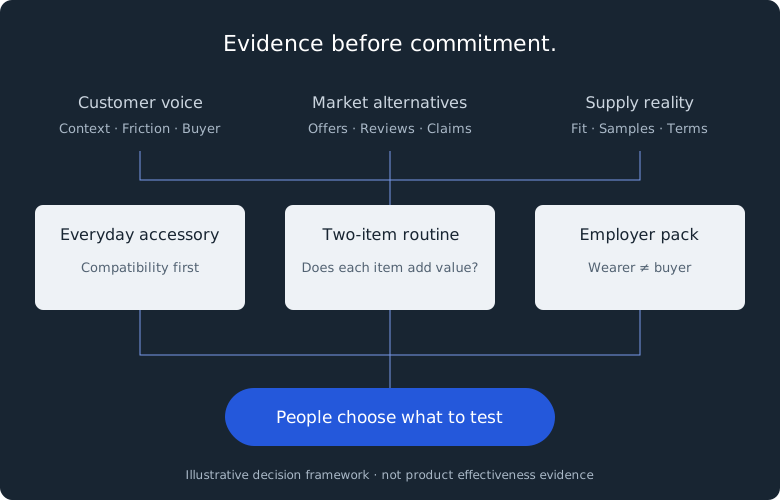
AI Business teammates can investigate different parts of the question in parallel, then join the findings around the same candidates. One workstream reviews customer language and recurring complaints. Another compares existing offers, prices and advertising. Another examines published research and the limits of its relevance. Supply research checks available formats, sample access and likely delivery constraints.
The useful output is not a pile of links. It is an evidence register: an observation, its source and date, the audience and context, the interpretation, and what remains unknown. A complaint about an insole moving inside a shoe might suggest a fit problem. It does not establish how common the problem is. Repeated advertising shows an angle is being used; it does not reveal its profitability.
Search patterns, reviews, interviews and product listings answer different questions. Agreement between them can strengthen a hypothesis. Disagreement tells the team where to look next. Keep negative reviews of the proposed format and evidence for competing solutions visible alongside supporting material. Otherwise, the investigation becomes an exercise in defending the first idea.
Compare three angles on the same questions
An angle combines an audience, a problem and a reason to consider an offer. It is more specific than “comfort for everyone.” For the hypothetical investigation, compare these candidates without awarding artificial scores that imply evidence we do not yet have.
Scroll across to compare all columns.
| Candidate angle | What must be true | Evidence that could change the choice |
|---|---|---|
| An everyday shift accessory | Wearers can use it with their existing shoes and see enough value to pay | Fit complaints, actual alternatives, willingness to try a sample |
| A simple two-item routine | The items solve connected practical needs and remain easy to use | Whether the second item adds value or only raises price and complexity |
| An employer starter pack | A workplace buyer has a reason and a route to purchase for several people | Procurement interviews, sizing and distribution needs, replacement responsibilities |
Each candidate needs the same discipline. Who pays? What are they replacing? Which product properties matter? What can be stated responsibly? Can the offer be sourced consistently? What would make the business stop?
The employer pack might initially look attractive because one order could include several units. It could also introduce a longer decision process and more coordination. The two-item routine might appear more complete while adding a product nobody asked for. The everyday accessory might be easier to explain but difficult to distinguish. These are competing hypotheses, not findings.
Let sourcing challenge positioning early
Product availability should influence the research before an angle becomes a brand promise. Suppose a sample does not fit common footwear in the chosen context. The team should revise the proposition rather than conceal that limitation behind better copy. If a bundle depends on two suppliers with incompatible lead times, that changes the comparison too.
AI Business teammates can connect sample observations, supplier questions and offer comparisons in a shared workstream. They can flag where a claim lacks support, where a specification is ambiguous and where a proposed feature would increase cost. People inspect samples, judge the quality of evidence and decide which compromises are acceptable. A summary cannot substitute for those decisions.
Choose the next test, not a finished business
A useful decision summary ends with a short proposition, the strongest evidence for it, the strongest counter-case and the assumptions that still matter. For example: test whether a narrowly defined group of self-purchasing workers values a compatible everyday accessory enough to choose it over its current alternative. That is a research direction, not a promise that the product works or sells.
The next test could combine a small set of structured conversations, sample evaluation and a clearer offer comparison. Set the question and decision rule before collecting answers. If fit is the central uncertainty, another week of competitor advertising research will not resolve it. If purchase motivation is unclear, a cheaper supplier quote will not resolve that either.
People choose whether to pursue, refine or reject the angle and approve any further spending. The practical outputs are an audience definition, a sourced comparison of alternatives, product requirements and a test plan. The same method works beyond workplace accessories: make the opportunity specific, connect the evidence and let constraints improve the idea before investment makes it harder to change.